Ask an agent who has worked Southeast Atlanta since around 2018 what they used to tell buyers choosing between Grant Park and Ormewood Park, and you'll hear a version of the same sentence: buy in Ormewood, pay somewhere between 15 and 25 percent less for a comparable house, and let the BeltLine catch up to you. The trail corridor running along Ormewood's western edge was always coming. It just took until this year to actually arrive, twice, in the span of about ten weeks. That timing matters more than most buyers realize, because the discount agents have been quoting since 2018 was never really about a finished amenity. It was about a promise. Promises price differently than pavement.
On April 16, 2026, the Atlanta BeltLine opened the last 1.2-mile stretch of its Southeast Trail, running from Boulevard to Glenwood Avenue and finally linking the Eastside Trail at the Krog Street Tunnel through Reynoldstown and Glenwood Park down to Boulevard Southeast, according to the Atlanta BeltLine. Atlanta BeltLine CEO Clyde Higgs described the opening as a milestone that residents of Glenwood Park, Grant Park, Ormewood Park, and Boulevard Heights had been waiting years for. Then, just two months later on June 18, the BeltLine completed Southside Trail Segments 2 and 3, a 1.9-mile push from Pittsburgh Yards to Boulevard that closed what the agency calls "the U," 16.7 continuous miles of the eventual 22-mile loop, fast-tracked to open ahead of the FIFA World Cup matches held in Atlanta this summer, according to the official June announcement.
That second opening is the one buyers comparing these neighborhoods tend to skip past, and it's the one that actually changes the math.
Why a connected loop is worth more than a finished segment
For most of the past several years, Ormewood Park's BeltLine access meant a local stretch of trail that dead-ended into construction fencing in both directions. It was real, but it was contained. As of this June, that same stretch of pavement runs continuously from Armour Yards in Northeast Atlanta down past Piedmont Park, through Boulevard Crossing Park and Chosewood Park, past Pittsburgh Yards, and up to Blandtown in Northwest Atlanta, reconnecting 36 neighborhoods along the way, per the BeltLine's own accounting.
That's a different asset than a nice local trail. A resident in Ormewood Park can now walk or ride a genuinely continuous route rather than a segment that used to require a car for anything beyond a mile in either direction. Atlanta BeltLine President and CEO Clyde Higgs framed it this way at the June ribbon-cutting:
"Twenty years ago, the Beltline was an ambitious vision," Higgs said at the ribbon-cutting.
The distinction between trail nearby and trail that actually goes somewhere is exactly the kind of thing a median price doesn't capture but a buyer walking the Southside Trail past Boulevard Crossing Park this month can feel immediately.
The gap that built up over a decade
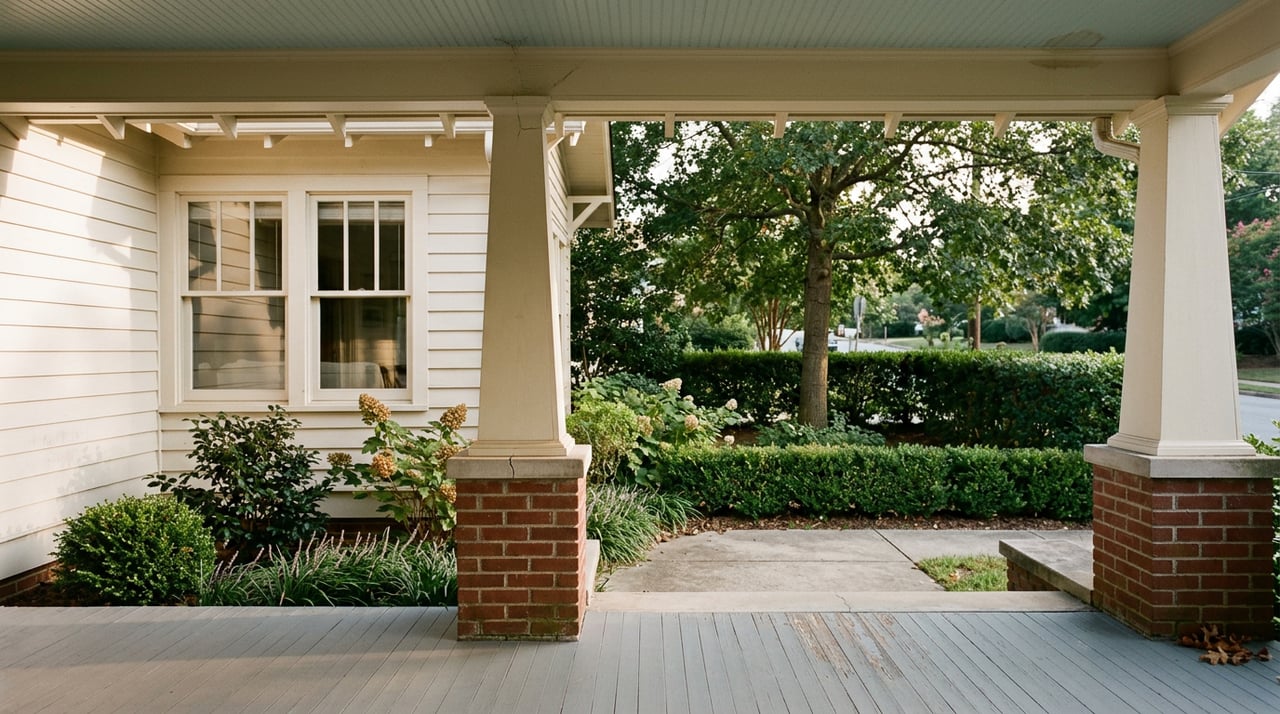
To understand why the discount existed at all, it helps to look at how it formed. Ormewood Park developed as a streetcar suburb beginning in the 1890s, and its housing stock today runs from Victorian cottages to 1920s Craftsman bungalows on streets like Wabash and Boulevard, built decades before anyone imagined a rail corridor running past it. For most of that history, Ormewood traded at a real discount to Grant Park because it was simply farther from downtown amenities and had no particular reason to command a premium.
The BeltLine changed the story before it changed the pavement. Years before either 2026 trail segment opened, developers were already pricing new construction in Ormewood as if the trail were finished. The clearest example is the Farmhouses at Ormewood Park, a small enclave of standalone new-construction homes built directly on the unpaved BeltLine corridor. One of those houses went under contract for more than $1.2 million, a figure widely described at the time as a neighborhood record, years before the trail segment beside it was anything more than dirt and a construction fence, according to reporting from Urbanize Atlanta. That sale wasn't buying a finished amenity. It was buying a bet.
Speculative bets like that are exactly what tend to unwind once the thing being bet on actually exists. The uncertainty that justified paying a premium for proximity to an unfinished trail disappears the moment the trail opens to everyone equally.
Where the discount already looks thin
Inside Ormewood Park today, the spread between a turnkey interior-block house and one that fronts the BeltLine or sits near Glenwood Park tells the story on its own.
| Location within Ormewood Park | Typical price range |
|---|---|
| Turnkey homes on interior streets | Low $400,000s |
| Homes on or near the BeltLine, or near Glenwood Park | $600,000 to $1.5 million |
That gap, low $400,000s versus $600,000-plus, is roughly the same order of magnitude as the historic 15 to 25 percent discount Ormewood carried against Grant Park as a whole. In other words, the neighborhood premium that used to separate two zip codes has increasingly relocated to separate two blocks within the same zip code. Trail frontage now does inside Ormewood what an entirely different neighborhood used to do.
The part of the discount that has nothing to do with the trail
Not all of Ormewood's historic gap was ever a BeltLine story, and this is where a lot of buyers get the analysis wrong. The blocks in northern Ormewood sit close enough to I-20 to hear interstate traffic at most hours, a condition worth experiencing in person during morning rush before signing a contract. That noise discount predates the BeltLine entirely and has no reason to close just because a trail segment two neighborhoods away finally connected.
This is the distinction worth sitting with if you're comparing these two neighborhoods right now: part of the price gap was always a walkability bet that has now resolved, and part of it is a permanent interstate-adjacency discount that pavement a half mile south will never touch. Conflating the two leads buyers to either overpay for a quiet interior block that never had the discount to begin with, or underpay attention to noise on a BeltLine-adjacent block where trail access alone won't offset it.
What the citywide numbers are actually hiding
Zoom out and the average intown Atlanta sales price for single-family homes rose about 5 percent over the twelve months ending in mid-2026, with average days on market running around 45, up roughly 12 percent from a year earlier. Those are the kind of headline numbers that make the whole market sound like it's moving in one direction.
It isn't. Of the several dozen intown submarkets tracked in that same period, roughly a third saw their average sales price decline even as the overall figure climbed. The BeltLine-adjacent pockets, Grant Park, Ormewood Park, Glenwood Park, are doing a disproportionate share of the work pulling that average up, while intown neighborhoods without a comparable amenity story are flatter or softer. A citywide or even a submarket-level median tells you almost nothing about which specific blocks are absorbing that appreciation and which aren't.
The friction buyers are running into right now
Here's the practical wrinkle. Appraisals lean on closed comparable sales, typically pulled from the trailing six to twelve months. Right now, most of the closed sales sitting in an appraiser's file for a block near the newly completed trail segments still predate that completion. A contract price that reflects the neighborhood's new, better-connected reality can run into an appraisal built on the neighborhood's old, less-connected one. That gap doesn't resolve itself until enough post-completion sales close and work their way into the comp pool, which typically takes a couple of quarters in a market with this much transaction volume.
If you're actively comparing Grant Park and Ormewood Park this fall, a few things are worth doing before you write an offer:
- Ask your agent to pull comps dated after April and June 2026 specifically, not a blended twelve-month average that mixes pre- and post-completion sales.
- Separate the block's distance to the trail from its distance to I-20. They pull the price in opposite directions and get lumped together far too often.
- Expect appraisal conversations on trail-adjacent blocks to take more explanation than usual for the next couple of closing cycles, simply because the comp data hasn't fully caught up to the neighborhood yet.
Frequently asked questions
Is Ormewood Park still cheaper than Grant Park in 2026? On average, yes, but the margin that mattered for a decade was tied to an unfinished amenity. With both neighborhoods now sitting on the same completed, continuous trail, the part of that margin tied to speculation has largely closed. What's left is closer to a genuine, and narrower, walkability and inventory difference.
Does being near the BeltLine automatically add value to a house? Not on its own. Northern Ormewood blocks near I-20 show that proximity to one amenity doesn't cancel out the discount from proximity to a different, less desirable one. Trail access and interstate noise are two separate variables that happen to overlap in this neighborhood.
Should I wait for prices to fully settle before buying near the trail? That depends more on your financing timeline than on the market. If you're financing, budget extra time for the appraisal conversation over the next couple of closing cycles while comparable sales catch up to the trail's completion. If you're paying cash, that friction mostly disappears.
The mechanism behind this shift, a decade-long speculative discount closing in the span of two ribbon cuttings, is the kind of thing that only shows up when you're tracking a neighborhood block by block rather than glancing at a portal's median. If you're weighing Grant Park against Ormewood Park, or any other pairing of intown Atlanta neighborhoods, that's the level of detail Team Rich Richardson works at every day. Get your instant home valuation and let's talk about what your specific block is actually worth right now, not what the neighborhood-wide number says it's worth.